
skies over knees
NEW POETRY INSPIRED BY BIOPHILIA

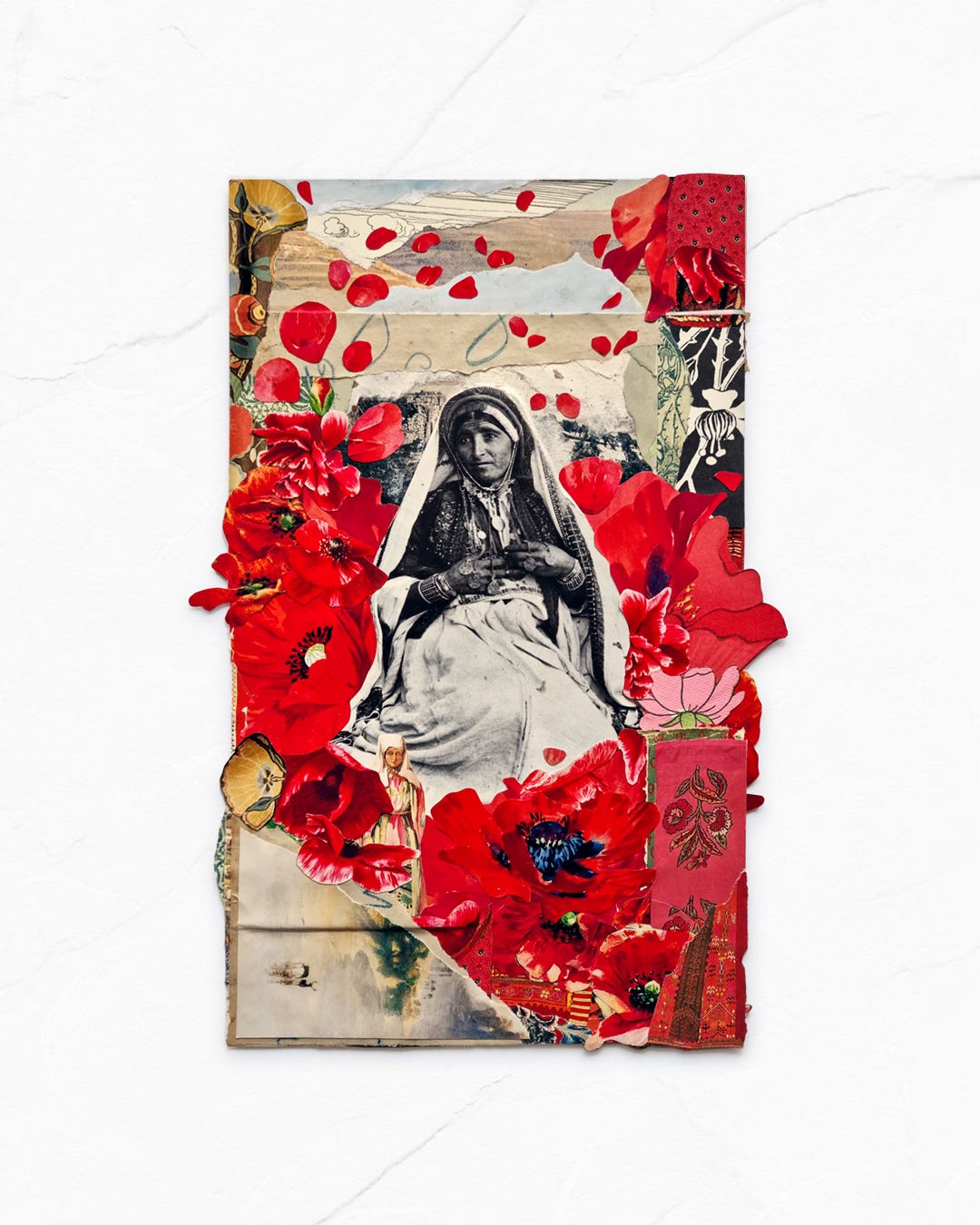
one hundred thousand petals open. dogs snuff and roll in grass. we talk less and less. we are tree more and more. a bee lands on an arm. frog choral. a blackbird on the window ledge. the swifts squeal their O joy of flight across the roofs. i watch their brown bodies from the tallest opening duck and weaving the air with unseen cloth. the wild herd graze at the edges as they always do. the poppies lour each and every hedgerow.
i am so pleased to offer you the final curated poems plucked from our biophilia submissions. last month i made an error and published our May selection so now you are receiving April’s. eek! we are so thankful to all of the incredible writers who have offered their work, look out at the end of June for new poetry received in our recent submission window.
APRIL
Katy Luxem

The sky loosens,
tilts as if the sun
is a bulb on a horizon
of dirt and grass.
The mountains are collars
against a face
of snow looking down.
One day warm, another
requiring traction to move.
We are unsure
if it will flood or hold.
Every day is a question
of too much or not enough.


TIME IS A FOREST
Purbasha Roy


That day the dream punctuated me
with a line Time is a forest. It was
you near me. Your voice kept falling
on me like answers. A spent wind
touched us, the way a train whistle
while it chugs else destination. The
museum of light translate dark to
a thing beyond itself. A sensation
crowds my chest. Is it a story I'd
wanted to tell you or the memory
of time we were in two different
corners of this world. How I had
wanted to be with you as if on the
same escalator step. Time burgeoning
around us. With liberation to become
anything without addition of aches.
Our story not about sadness. Some
mornings my body seems to be
rejuvenated by dreams by its
offerings  of you. Thus, do what it
comes to do like forests on earth.


SPORESONG
Ryan Hooper

I enter the forest split open, my skin a seam willing itself permeable. The air seeps in –
breath returned from ten thousand lungs – and settles inside me, cold between the ribs. The trees lean, slow and animal, acknowledging my marrow as if it had always belonged here. Moss thickens underfoot, swallowing the weight of giants long buried.

Below, the mycorrhizal net pulses. Roots speak in thirst, knotting their truths into one another. I kneel to touch toothwort – its stem trembles, wet with ascent. It drinks shadow into bloom with an alchemy I recognise in my own bones. Leaves curl at my passing, folding like hands around secrets they refuse to share.

Here, the ground transforms decay into fertile dreaming. Mulch clings like memory – it breathes against my soles, thick with the language of what died and chose to remain. But death is not absence, it is breath moving in reverse. And as the sporesong rises from the earth’s throat, it nests in the hollow places where wonder lives.

Above, treecreepers spiral skyward, carrying the forest’s whispers up through the bough’s skin. I follow with my eyes – see sky not as distance but as sorrow stretched thin. This vast grief feeds the roots below, connects canopy to soil in one breathing.

I see eternity in how the branch breaks – softly, bleeding scent. In how roots cradle the weight of my step, how bark keeps the print of my hand. Touch comes before understanding. And understanding comes as homecoming.

I cannot leave.

Moss has erased my footprints. The trees guard my warmth in their rings.

And in the hush, the sporesong waits – mouthless, patient – ready to breathe itself
into the next open body.


WHITE HORSES
Tim Willmott

humming like a hive
landing blunt words
sipping foamy nectar

I butterfly sway
through the open door
saunter onto the beach

swell over knees
rips into turbid murk
swim parallel to shore

breathe between chop
dive, a young salmon
yellow-mottled beautiful smolt

cast your lines in autumn
when I return, to fight my way
over weirs, to cool gravel beds


READING THE HILL
Elizabeth Rimmer

Water runs beneath clay and beds of stone.
Kirk Burn calls to West Burn, Light Burn
to Calder Water. Gulls cry from White Cart
to the Clyde. I look across a burning gulf
of hawthorn, rowan, elder and fading leaves.
This garden speaks in sow thistle, mudstone,
spider and slug. I say to it apple trees.
It says elecampane. It says roses here,
not there. Leaf cutter and chafer live there.
Leave them be. It talks of ghosts of orchards,
plum trees underset with berries all lost
to suburbs. This hill gives me couch grass,
bistort, red clover, wild apples, magpie, fox,
bird cherry and children lost in the tangle
of overgrown uncut grass, waist high,
and a high thin wisp of yelling goose skeins
almost lost to sight. It is ruled by things
that were here before I was. It will wait
until I learn. It will do as it likes.


THE WALKING SUN-
Devika Mathur

beneath corals of huge rocks,
I see the Sun
perching quietly, almost screaming in quietness
about it’s worries
and tamed morality-
hushed, with walnut backbone,
it shines orange and cries black-
solitude roped against its star-tongued neck
Fern-skinned it cries about humans
and their lost connection to the forest
it tells tales about the earth weeping
about the lost tranquility between its tongue and our palms,
the wetness and dryness-
Moss throated Earth cries and weeps!
The walking Sun sees it all-
watches it vehemently and walks yet again
to quieten the soil, to bloom somewhere again.


A MEDITATION ON THE ALLEGHENY PLATEAU
Nathan Erwin

A flurry of nighthawks passes over the Chemung
scattering soft mist along the river. A delight to be alive.
A dewy door to sizzling blood & play seen
through a screen window by a child waiting for sleep
& by the tall sunflowers waiting for day. At Corning Glassworks,
tiny bits of crystals fuse overnight in the kiln
waiting for the old gaffer’s blade jacks. & in the hills, as the gas flares falter,
a guerrilla group of earth workers, Seneca & Cayuga, sow
a thousand ancient seeds in soil burned by slurry. It is through these small mounds
of millennia that the sun inside the earth
can glow. 				  A crystalline crack of beginning.
Katy Luxem lives in Salt Lake City. She is a graduate of the University of Washington and has a master’s degree from the University of Utah. Her work is anthologized in Love Is For All Of Us (Hachette, 2025) and has appeared in Rattle, McSweeney’s, SWWIM Every Day, One Art, Poetry Online, and many others. She is the author of Until It Is True (Kelsay Books, 2023).

Purbasha Roy is a writer from Jharkhand India. Her work has appeared or is forthcoming in Iron Horse Literary Review, The Margins, Strange Horizons, Reckoning Magazine, Notch Review as of late. Attained 2nd Position in 8th Singapore Poetry Contest. Best of the Net Nominee. Website: https://linktr.ee/Purbashawrites

Ryan Hooper is a Cornwall-based writer, artist and sound maker whose mixed media work explores the intersections of memory and landscape. His writing has appeared in a range of journals and magazines, and his published collections include Relief, No Description Only Love, and the novel A Map and Not a Tracing (Heavy Cloud Press).

Tim Willmott lives in the Chilterns and is interested in folklore and the natural world. He has started writing again recently and has poems to be published later this year. Tim works in film campaigns and makes his own cider.

Elizabeth Rimmer is a poet and editor. She has four collections with Red Squirrel Press, Wherever We Live Now, The Territory of Rain, Haggards, and The Well of the Moon. Her work has been translated into French, Arabic and Gaelic, and her poetry appeared on the side of a bus. Her next collection Comrades of Darkest Night about hauntings, othering, transformations, healing and creativity, will be published by Red Squirrel Press in March 2026.

Devika Mathur is an Indian poet, writer, educator, and editor. Her work has appeared in The Alipore Post, Madras Courier, Modern Literature, Two Drops of Ink, Dying Dahlia Review, Pif Magazine, Spillwords, Duane's Poetree, Piker Press, Mojave Heart Review, Whisper and the Roar, and more. She is the founder of Olive Skins and the author of Crimson Skins. Her poetry is also featured in Sunday Mornings River, Parcham, and Poets Espresso Review.

Nathan Erwin is a poet and land-based organizer from the Allegheny Plateau, the northernmost tier of Appalachia. He currently operates with the Pocasset Wampanoag tribe as they fight for land, food, & seed sovereignty. His writing has recently appeared in the North American Review, Boulevard, The Journal, Gulf Coast, and Ninth Letter. His organizing and his poetry are conversant, and so he writes about foodways, myths, medicine, and wanting.